UbiStake - a staking and dividend distribution platform
UbiStake is the staking service of the Ubix.Network ecosystem. It started as a replacement for third-party services that had stopped being reliable, and ended as a rebuild of the whole ecosystem: single sign-on across every product, in-house analytics, and a mechanism that distributes a business's profit among the holders of its token.
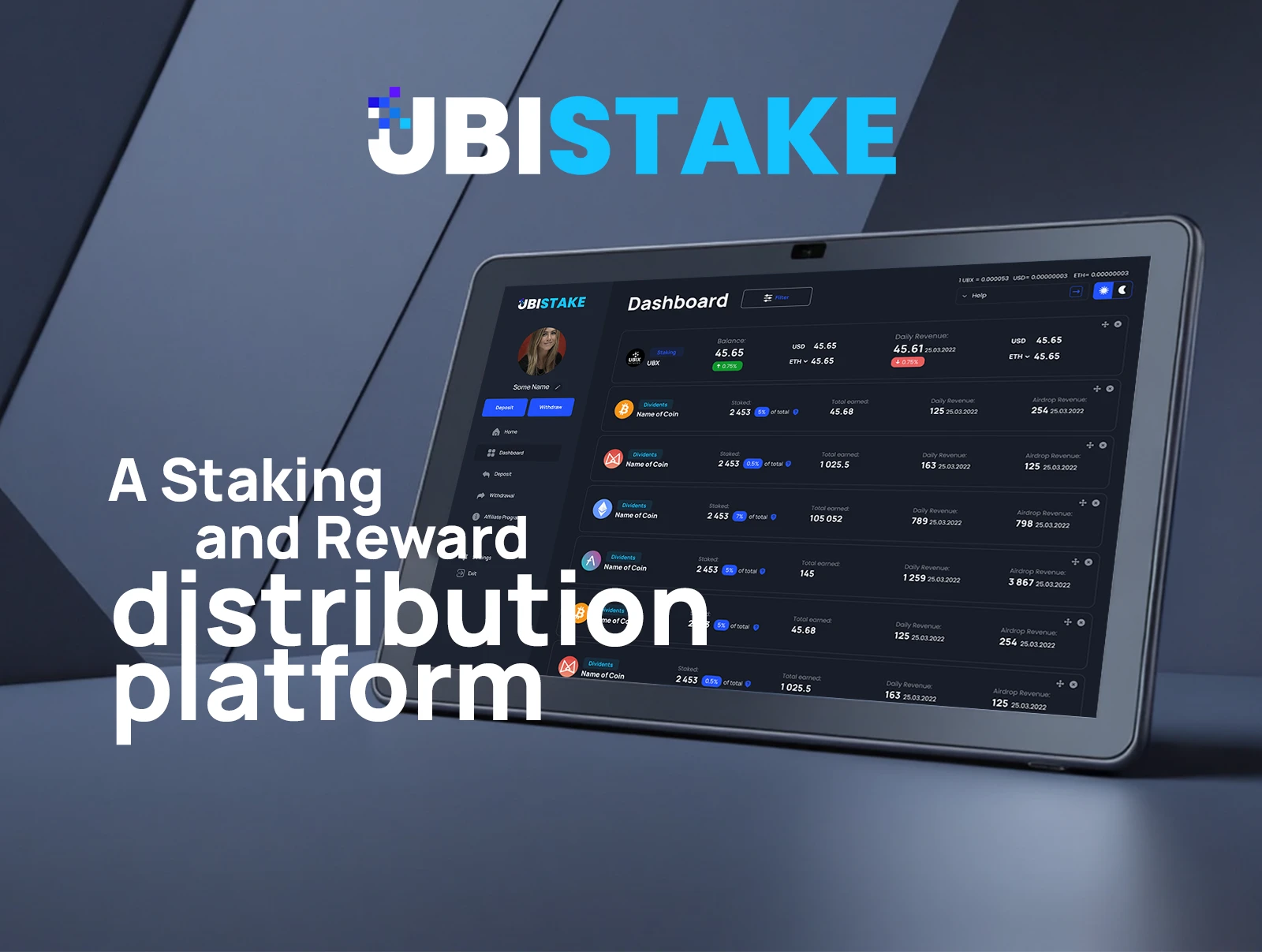
- Client
- Ubix.Network
- Industry
- Blockchain, Fintech
- Services
- Web3 and blockchain, Backend, Frontend, Design, Analytics, Bots, On-Line services, Outstaff, Web development, Software, DevOps, Corporate systems, Prototyping, MVP development, Web3 experience, Technical audit, IT consulting
- Period
- 2021-2025
Why we took it on
Before staking, the ecosystem had an exchange and a network explorer. Staking ran on third-party services - right up to the moment they began to fail. First one was down for a day or two, then another, then several went dark almost at once. The exchange and all token operations sagged with them: holders' income depended on someone else's infrastructure that nobody could influence.
The answer suggested itself - build our own staking. But one service was not enough: it would still have been a separate island with its own registration. So the task was set wider.
- Our own staking with automatic accrual and withdrawal without lock-up.
- Single sign-on across every ecosystem service that has a login and password.
- In-house analytics instead of guesswork about what is going on.
- A way to verify any accrual without taking anyone's word for it.
Project goal: a convenient and secure staking service for the Ubix.Network ecosystem
Single sign-on
A separate identity server took over registration, sign-in and access rights. Applications stopped storing credentials - they ask the server over a REST API.
The exchange, the notarisation service and the document signing service moved under the shared login. Then we made the transition seamless: a person clicks a link to a neighbouring service and lands there already signed in, with no second password prompt.
The wallet is deliberately left out of single sign-on: there, access to funds comes from the seed phrase, and adding an external account to it would weaken the protection.
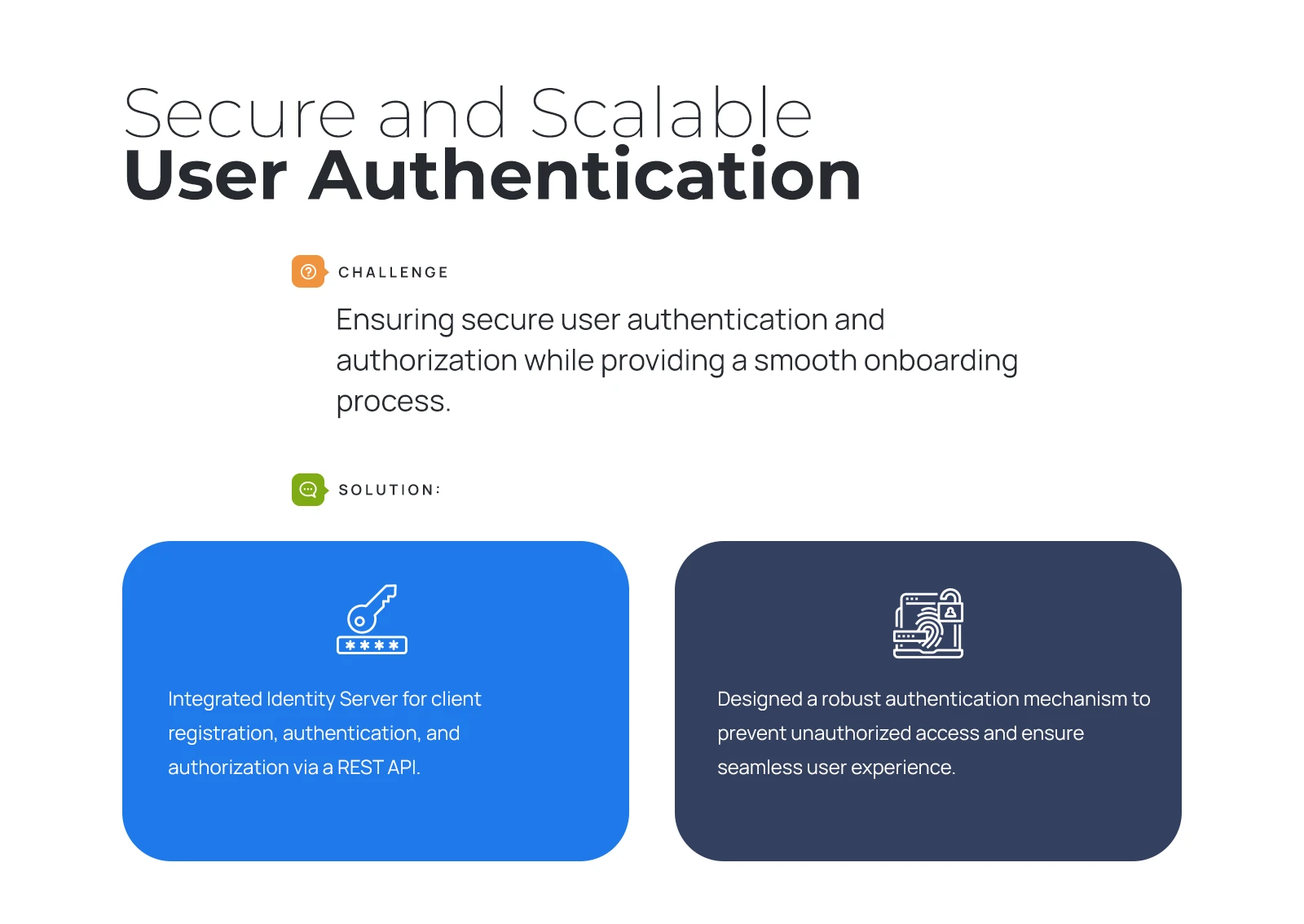
Secure and scalable authentication: an identity server with REST API access
Staking and reward distribution
At the core of the service is a contract that accepts UBX and other ecosystem tokens for staking and calculates the reward itself.
Automatic calculation
The reward depends on the amount and the term, and is calculated with no human involved.
Daily airdrops
A token holder receives a share in proportion to how much they hold.
Scheduled payouts
Dividends arrive on a schedule rather than on request.
No lock-up
Funds can be withdrawn at any moment.
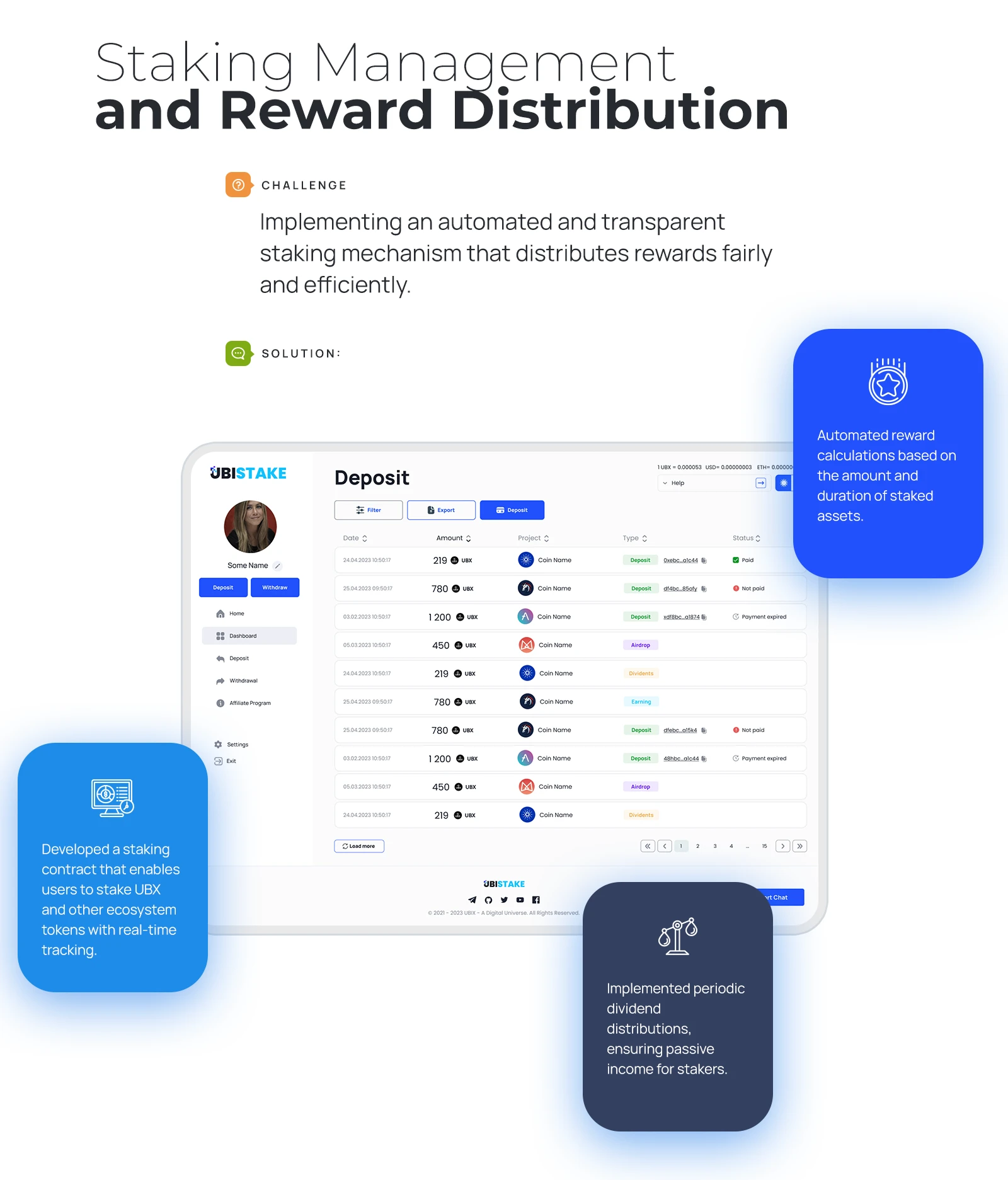
Managing staking and distributing rewards inside the service
Profit distribution for user-issued tokens
This part appeared once two things came together: single sign-on and a service for issuing tokens without code.
An entrepreneur issues a token for their business, gives it their own ticker and sells it - that is how they raise investment. When the business starts making a profit, they transfer the share agreed with holders to the service address of their token. The system takes it from there: it looks at who holds how many tokens and distributes what arrived in proportion.
Held ten per cent of the issue - received ten per cent of the distributed sum. No code, no smart contracts written by hand: both sides work with buttons in a dashboard.
An accrual can be checked in any service - in the wallet, on the exchange, in staking itself - while the full picture on top of the blockchain is shown by the network explorer.
Payments and protection of funds
An integration with a payment service generates a one-time address for every deposit, and a withdrawal is confirmed by a separate step with a limited time window. The one-time address solves two problems at once: the payment is unambiguously linked to the user, and reusing an address becomes impossible.
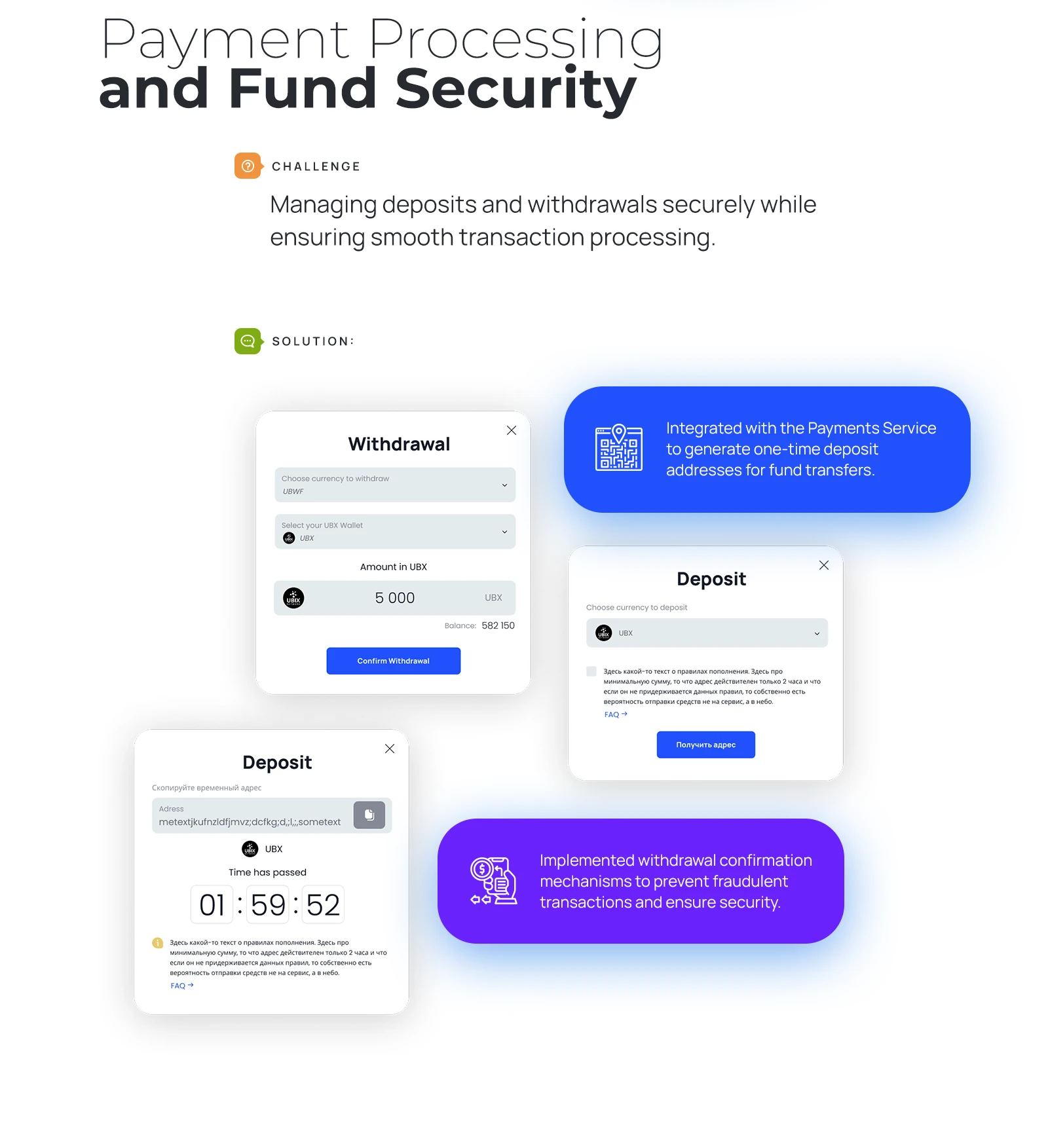
Payment processing: one-time deposit addresses and withdrawal confirmation
Monitoring and analytics
A separate service collects statistics on staking and payouts. The admin panel shows it in real time - and not only for the admin: users saw their own slice of the analytics right inside the service.
This turned out to be the most demanding part. The same data had to be shown to two different audiences without mixing anything up: the whole picture for the administrator, only their own figures for the individual. In finance the price of a mistake here is not "inconvenient" but a leak, so access separation took longer to think through than collecting the statistics did.
This was the beginning of the in-house analytics for the whole ecosystem - a separate product that gathered the spending of more than ten projects in one place and hands the figures on through the same role model: reports on an internal dashboard for managers, API for the services. The report on accruals and airdrops that a user sees here comes from exactly there. The screenshots of that system are covered by a non-disclosure agreement, so its case is text only.
Performance monitoring and data analysis: staking statistics in real time
Network explorer
The explorer is the final checkpoint for every service of the ecosystem. Whatever staking, the exchange or the wallet may display, any accrual and any transaction can be verified directly against the blockchain.
No design requirements were set, so the interface was prototyped in Quasar: the ready-made components were enough to make the data visible and workable. The prototype stayed on as a working tool.
The substance was underneath it. We wrote the server side in full, and several years later moved it to a fresher stack.
Infrastructure
The backend runs on Node.js 16+ with a modular architecture: new things are added as separate parts without touching what already works. The main storage is PostgreSQL.
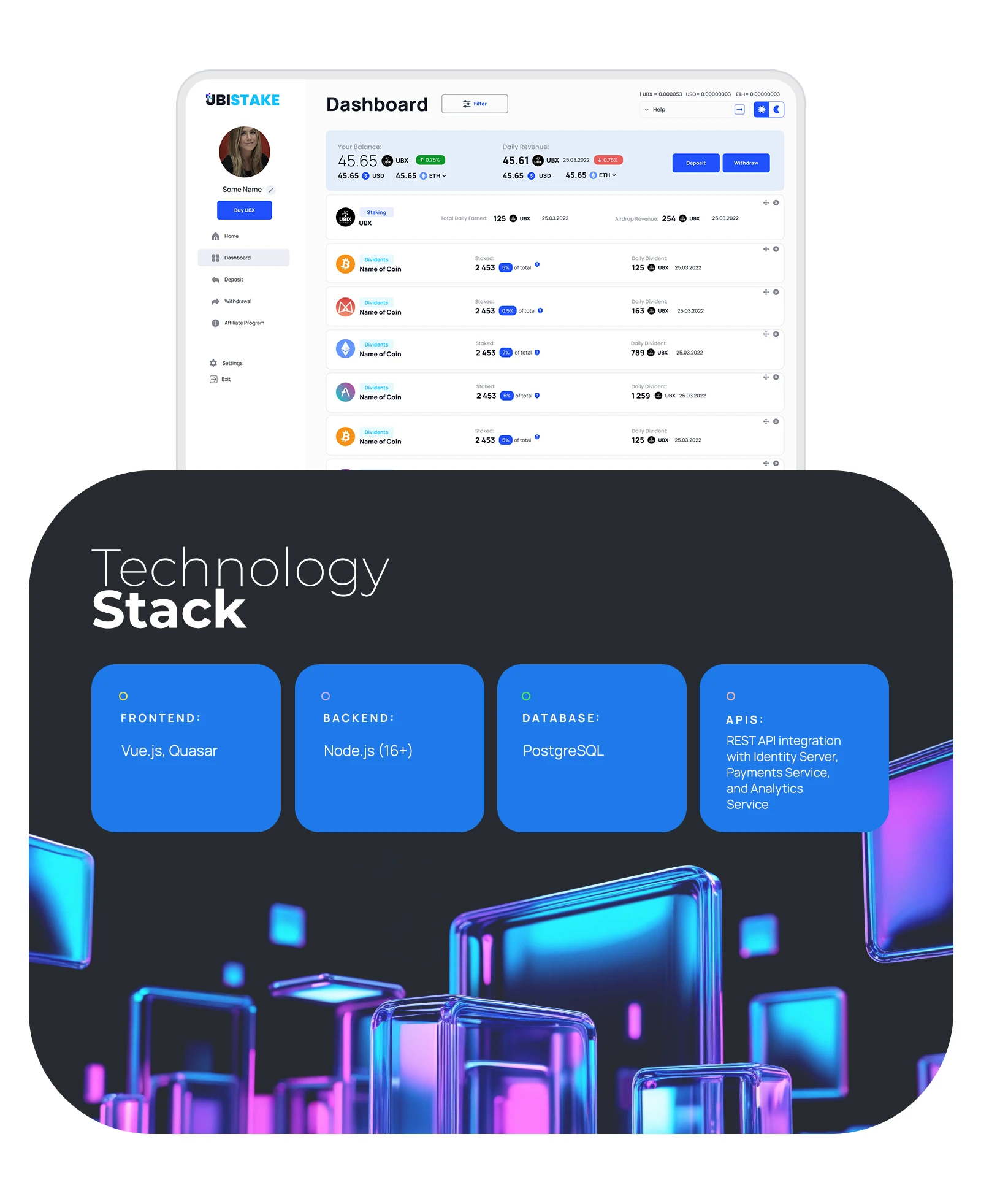
UbiStake staking platform technology stack 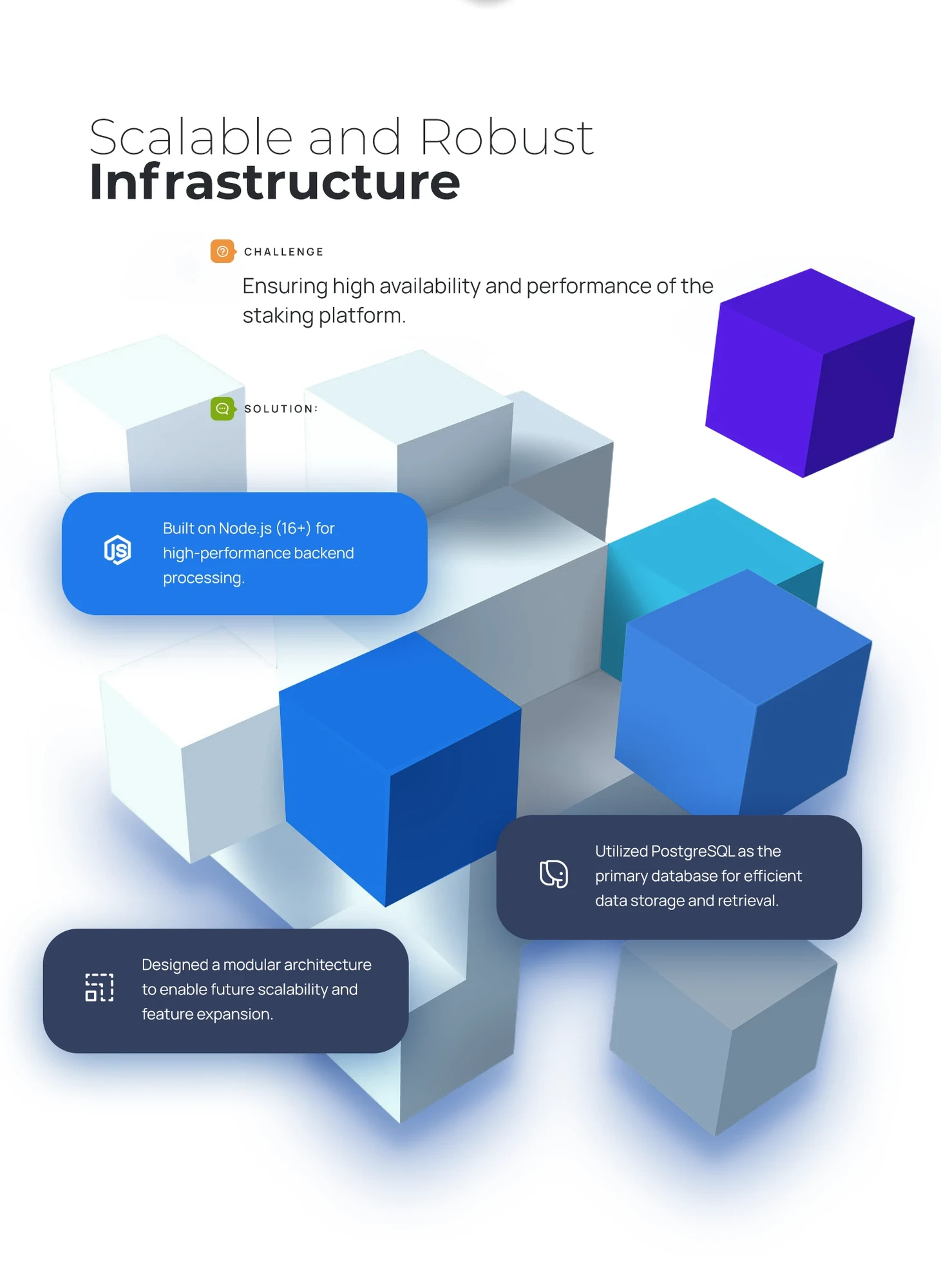
Scalable and reliable infrastructure: a modular architecture on Node.js
Interface
A dashboard in light and dark themes, each worked out separately. Deposit, withdrawal, settings and operation exports sit on one level, with no nested menus.
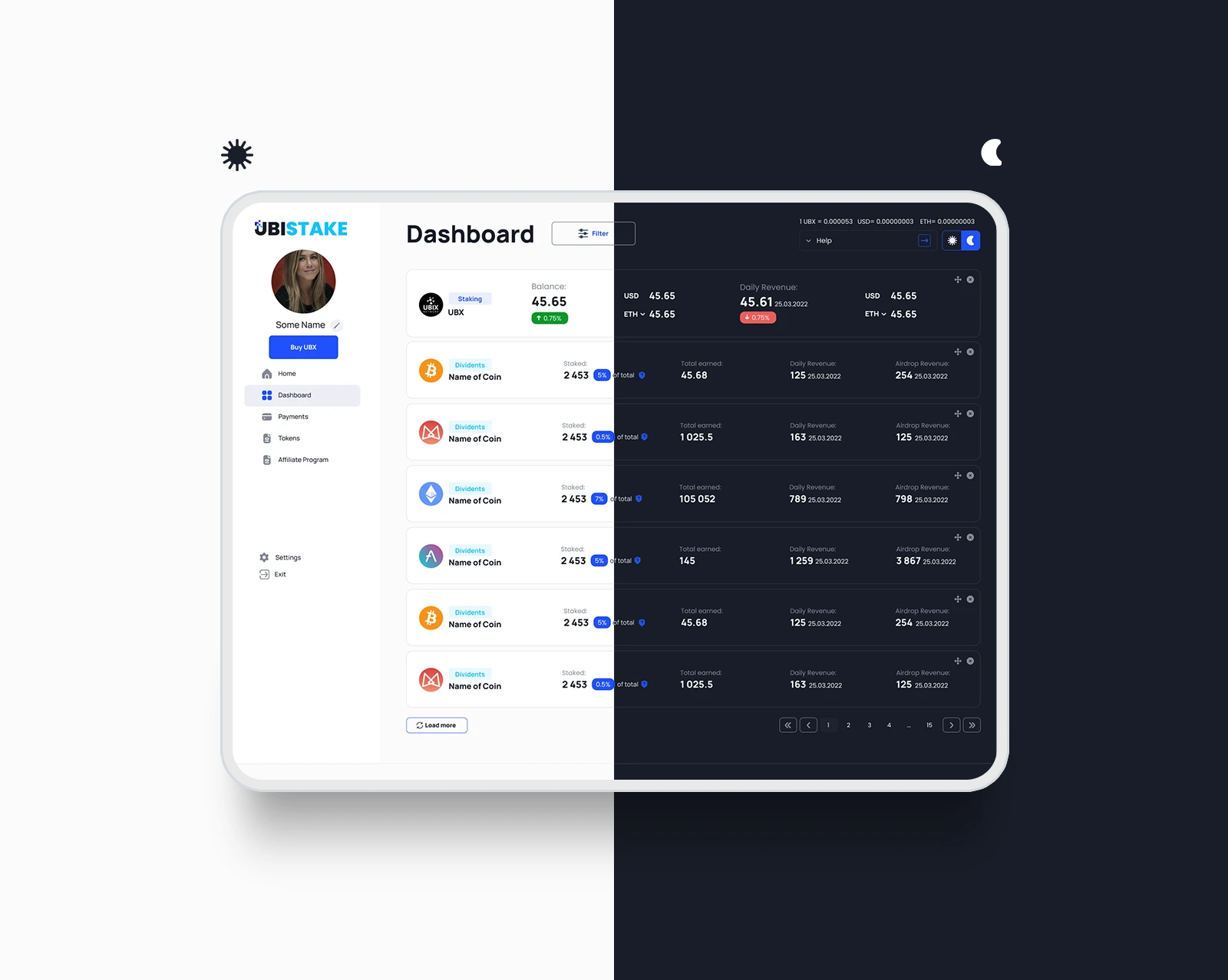
Dashboard in light and dark themes 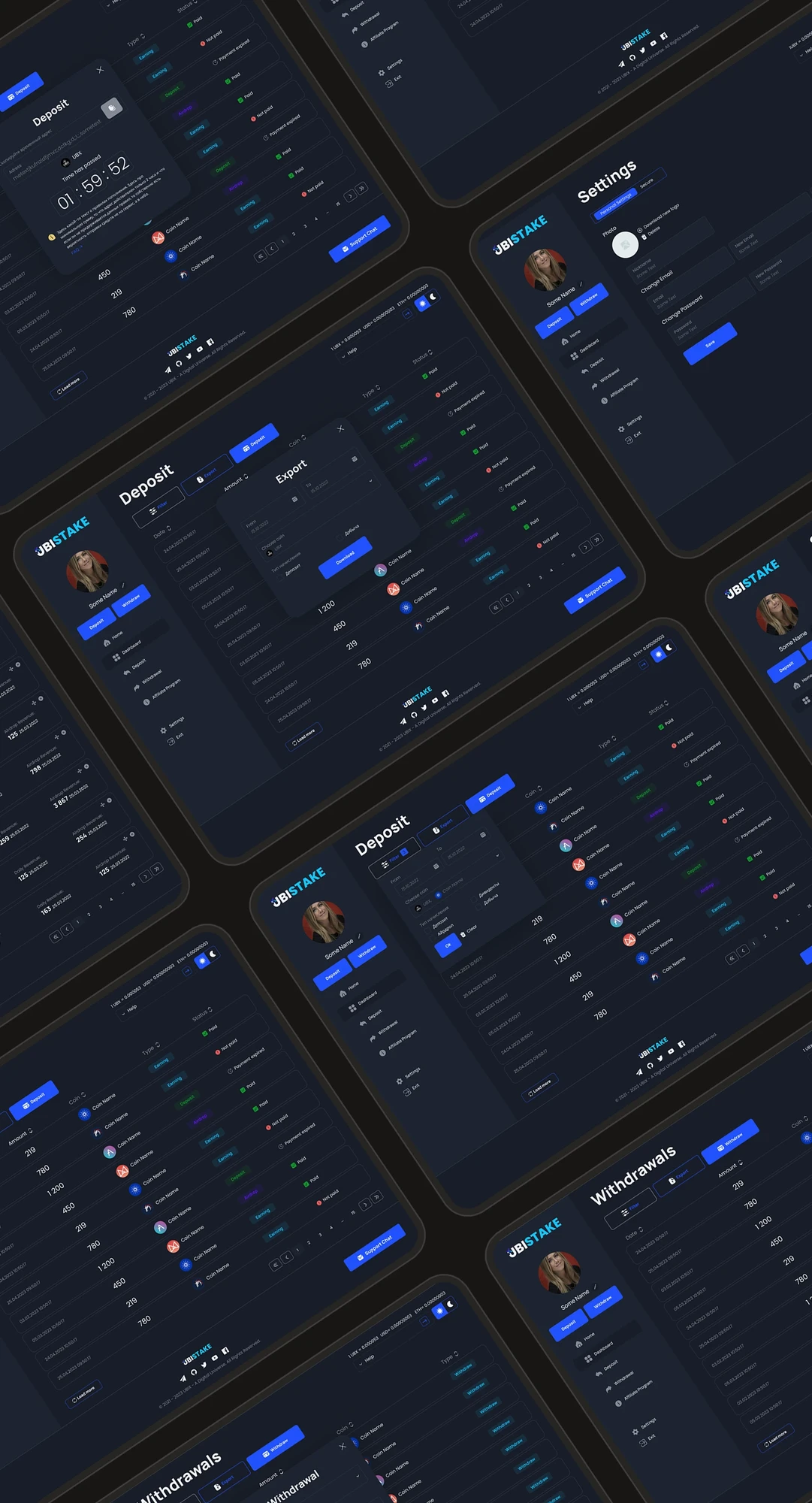
Service screens: deposit, withdrawal, settings and operation exports

Thank you for viewing the FAMOUS.TEAM case on staking platform development for UbiStake
UbiStake staking platform stack
What the project is made of
The agency services it took to launch it.
- ServiceWeb3 and blockchainDevelopment of Web3 solutions that people trust with their money: smart contracts, wallets, trading and staking platforms, decentralised applications.
- ServiceBackendBackend and API development: a server side that holds the load, keeps the data and updates without stopping the service. We take the project as a separate stage or place a devel...
- ServiceFrontendFrontend development and markup to order: we build an interface that holds up equally on a phone and on a wide monitor, opens fast and stays readable on real data. We take the p...
- ServiceDesignWebsite and interface design by a team with experience both in design and in production frontend for products like these. So what is drawn gets built without surprises, whoever...
- ServiceAnalyticsDashboard and monitoring system development: we collect data from different systems into one picture and show what decisions are actually made on.
- ServiceBotsTelegram bot and chatbot development that takes manual work off people: intake of requests, moving data between systems, alerts about events and answers to routine questions. Ev...
- ServiceOn-Line servicesCustomer portal and online service development for products people use regularly. We answer for the technical side and for giving the business clear figures: where a person stop...
- ServiceOutstaffStaff augmentation for your development team: the person works by your rules, inside your process and under your management. We answer for their qualification, the paperwork and...
- ServiceWeb developmentWebsite and web application development end to end: from the first conversation about the task to launch and support. We build things that live in the browser and have to withst...
- ServiceSoftwareCustom software development for a specific business task: from a program on an employee desktop to a server service that runs without people. We build what off-the-shelf product...
- ServiceDevOpsDevOps and server infrastructure setup: builds, deployment, monitoring and backups arranged so that a release is routine rather than an event. We take it on as a single task or...
- ServiceCorporate systemsCorporate portal and internal systems development for employees: records, requests, approvals, reference data and reporting. We build around your process and connect it to what...
- ServicePrototypingApp and interface prototyping before a single line of code is written. A clickable prototype shows what a person will do in the product and where they will stop, and it costs se...
- ServiceMVP developmentMVP development is a working version of a product built small, made for one purpose: to test demand on real people rather than in a presentation. Finding out in a few weeks that...
- ServiceWeb3 experienceOur blockchain experience came both from individual commissions and from an ecosystem we ran for years together with its owners and their team. This page is about what we unders...
- ServiceTechnical auditA technical audit of what already runs: code, architecture, infrastructure, security and interfaces. The deliverable is a report with priorities: what to fix now, what can wait,...
- ServiceIT consultingIT consulting answers the question of how to build. Choosing technologies and architecture, planning the move off legacy systems, reviewing proposals from others. We hand over a...