Ubix.Network explorer
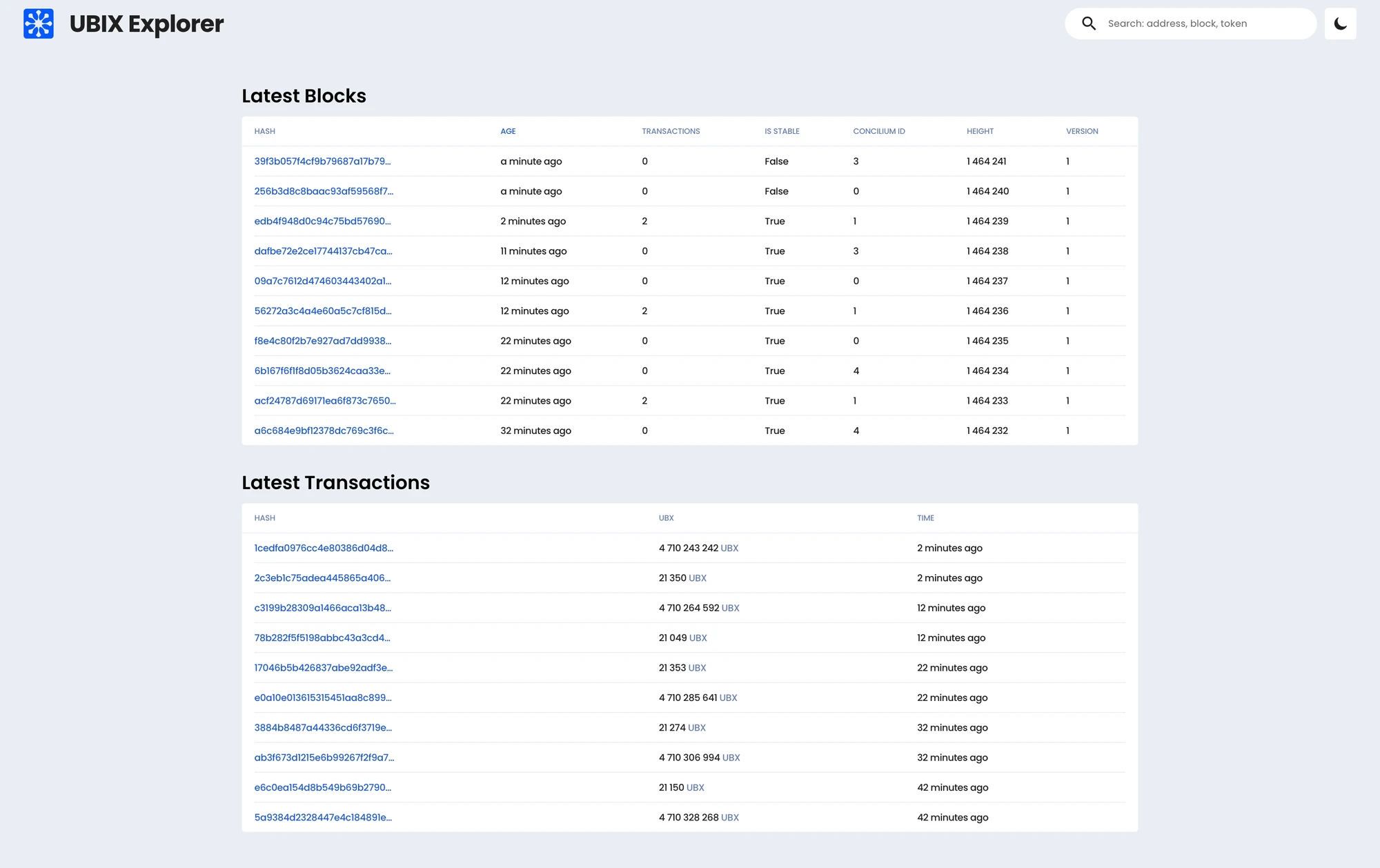
The Ubix.Network explorer is the single place where everything happening in the network is visible. Before it, each product of the ecosystem read only its own slice of the blockchain, and nobody saw the whole picture.
- Client
- Ubix.Network
- Industry
- Blockchain, Fintech
- Services
- Web3 and blockchain, Backend, Frontend, DevOps, Software, Prototyping, MVP development, Web3 experience, Technical audit
- Period
- 2021-2025
The task
The network served its data through the node RPC, and every service in the ecosystem pulled from it exactly what it needed for itself. The exchange saw its own trades, the wallet its own transfers, the staking platform its own accruals. All of these were truthful but partial pictures: no product showed an operation in full if it had passed through a neighbouring service.
The inconvenience was not about the interface but about verifiability. When funds move between products of one ecosystem, the question of where the money is now and what happened to it should not require visiting three services and assembling the answer in your head. What was needed was one place where any operation is visible in full, together with all its connections.
The prototype came before development
The project started with a prototype. The data was already in the network and the node served everything required: the work was not in obtaining it but in laying it out so that a person could make sense of it. Such things are cheaper to settle on a prototype than to argue about over static layouts.
It was on the prototype that the main thing was worked out: how to show the full picture of the network so that it reads without documentation.
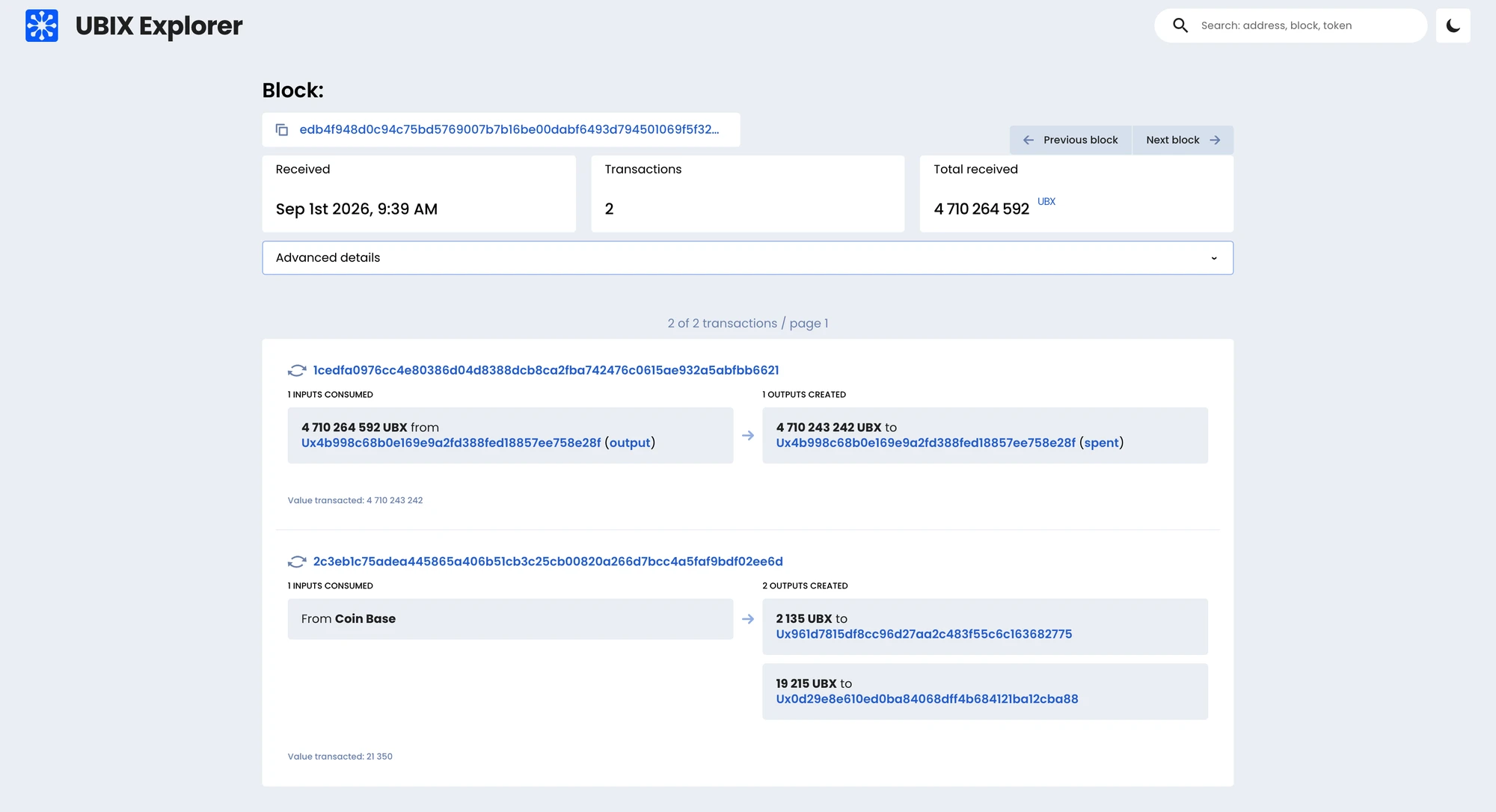
The block page: time, number of transactions, the amount and a breakdown of each operation into inputs and outputs
What came out of it
Any record in the network can be checked from one place. It does not matter which product the operation went through, a transfer from the wallet, a trade on the exchange or an accrual in staking: the explorer shows the operation itself, the block it landed in and the whole chain of records connected to it.
It works on the UTXO model rather than an account balance one: for every operation you can see which inputs were spent and which outputs were created, with coinbase ones marked separately. The network runs not as a single chain of consensus but as several concilia, and the concilium a block belongs to is visible as well. At the time of publication the network holds more than 1.4 million blocks.
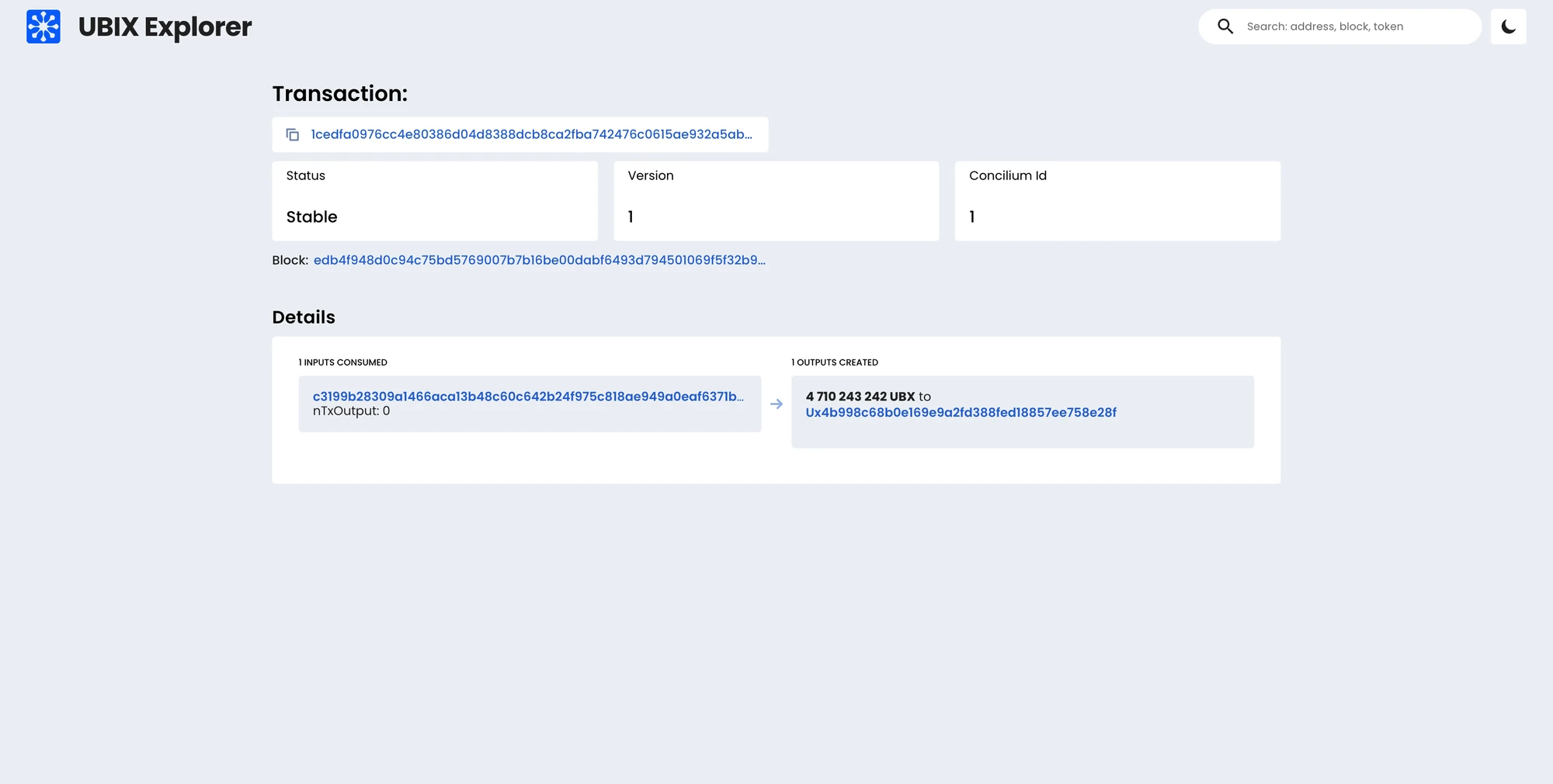
The transaction page: status, version, concilium and the link to the block
What happened next
Later the explorer moved to a fresher stack and bots from neighbouring projects were connected to it: they read the state of the network and react to events instead of waiting for someone to notice them by eye.
The project turned out small and technically undemanding, and we will not pretend it was a feat. Its value lies elsewhere: after it, the question of showing what happened stopped being an investigation.
Ubix.Network explorer stack
What the project is made of
The agency services it took to launch it.
- ServiceWeb3 and blockchainDevelopment of Web3 solutions that people trust with their money: smart contracts, wallets, trading and staking platforms, decentralised applications.
- ServiceBackendBackend and API development: a server side that holds the load, keeps the data and updates without stopping the service. We take the project as a separate stage or place a devel...
- ServiceFrontendFrontend development and markup to order: we build an interface that holds up equally on a phone and on a wide monitor, opens fast and stays readable on real data. We take the p...
- ServiceDevOpsDevOps and server infrastructure setup: builds, deployment, monitoring and backups arranged so that a release is routine rather than an event. We take it on as a single task or...
- ServiceSoftwareCustom software development for a specific business task: from a program on an employee desktop to a server service that runs without people. We build what off-the-shelf product...
- ServicePrototypingApp and interface prototyping before a single line of code is written. A clickable prototype shows what a person will do in the product and where they will stop, and it costs se...
- ServiceMVP developmentMVP development is a working version of a product built small, made for one purpose: to test demand on real people rather than in a presentation. Finding out in a few weeks that...
- ServiceWeb3 experienceOur blockchain experience came both from individual commissions and from an ecosystem we ran for years together with its owners and their team. This page is about what we unders...
- ServiceTechnical auditA technical audit of what already runs: code, architecture, infrastructure, security and interfaces. The deliverable is a report with priorities: what to fix now, what can wait,...